Dance Meditation för en bättre värld (Academy of Management)
- Aug 6, 2022
- 2 min read
Updated: Mar 15, 2023
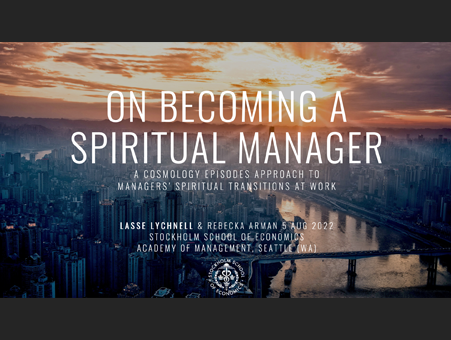
Lasse höll en professional development workshop vid världens största managementkonferens – The Academy of Management Annual Meeting – i Seattle i form av en dansmeditation som lockade professorer, doktorander och konsulter från hela världen. Nedan kan du läsa beskrivningen av workshopen på engelska.
"This experiential workshop invites you to explore dance as a mindfulness practice and reconnect with your body and yourself between sessions and presentations. No previous experience is needed, and everyone is welcome to join the inclusive space held by the facilitators. You may bring a water bottle and an extra T-shirt if you feel for it. Kabat-Zinn (1994) suggests that “mindfulness practice means that we commit fully in each moment to being present. There is no ‘performance’. There is just this moment.” We usually think about mindfulness practice as silent sitting, but there is no limit to our mindful practices. This is a moment to entirely turn your attention inwards as there is no choreography to remember and nothing to achieve. While we move our bodies to the rhythms of tunes from all over the world, we simply observe thoughts, feelings, and physical sensations from moment to moment without reacting and without judging. Compared to mindfulness meditation (Kabat-Zinn, 1990/2009), dance and movement in clinical and applied settings have received little scholarly attention. A recent literature review, however, suggests that “engaging in musical and dance activities can make people feel trust and connectedness, promote pro-social behavior within a group, and also reduce prejudices between groups” (Bojner Horwitz, 2021, p. 1). Other studies suggest dance may reduce depression equally effective as mindfulness meditation (Pinniger et al., 2012), and contribute to improvements in emotional and spiritual well-being (Marich & Howell, 2015), as well as pro-social behaviors, stress management, and communication skills (Barton, 2011)."
REFERENCES
Barton, E. J. (2011). Movement and Mindfulness: A Formative Evaluation of a Dance/Movement and Yoga Therapy Program with Participants Experiencing Severe Mental Illness. American Journal of Dance Therapy, 33(2), 157-181. https://doi.org/10.1007/s10465-011-9121-7
Bojner Horwitz, E. (2021). Can dance and music make the transition to a sustainable society more feasible?
Davis-Manigaulte, J., Yorks, L., & Kasl, E. (2006). Expressive ways of knowing and transformative learning. New directions for adult and continuing education, 2006(109), 27-35. https://doi.org/doi:10.1002/ace.205
Hagendoorn, I. (2003). Cognitive Dance Improvisation: How Study of the Motor System Can Inspire Dance (and Vice Versa). Leonardo, 36(3), 221-228. https://doi.org/10.1162/002409403321921442
Kabat-Zinn, J. (1990/2009). Full catastrophe living: using the wisdom of your body and mind to face stress, pain, and illness. Delta.
Kabat-Zinn, J. (1994). Wherever you go, there you are: mindfulness meditation in everyday life. Hyperion.
Lipson Lawrence, R. (2012). Intuitive knowing and embodied consciousness. New directions for adult and continuing education, 2012(134), 5-13. https://doi.org/doi:10.1002/ace.20011
Marich, J., & Howell, T. (2015). Dancing Mindfulness: A Phenomenological Investigation of the Emerging Practice. EXPLORE, 11(5), 346-356. https://doi.org/https://doi.org/10.1016/j.explore.2015.07.001
Pinniger, R., Brown, R. F., Thorsteinsson, E. B., & McKinley, P. (2012). Argentine tango dance compared to mindfulness meditation and a waiting-list control: A randomised trial for treating depression. Complementary Therapies in Medicine, 20(6), 377-384. https://doi.org/https://doi.org/10.1016/j.ctim.2012.07.003


Comments